Friday, July 27, 2012

Real-time rendered animation previews with Octane Render

This is a major breakthrough in rendering: the last version of Octane Render can now render complex animatable objects completely in real-time with path tracing. This has never been done before and is a game changer for animation previsualisation.

Real-time ray tracing of scenes with highly detailed dynamic objects has always been considered as a near impossible feat and has held ray tracing back as a rendering method for interactive applications such as games. Until now: we have adapted Octane in such a way that it can handle dynamic scenes effortlessly and in real-time without compromising the ultrafast GPU path tracing performance.

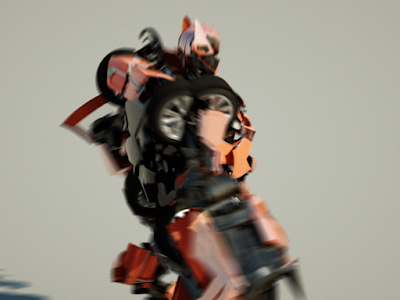
The following video was made with the Octane plug-in for 3ds Max and demonstrates that the acceleration structure of the animated robot can be updated instantly while rendering an instant preview of the lighting. The transformer in the animation was used before in a demo that I've made with Brigade some time ago (http://raytracey.blogspot.co.nz/2012/04/real-time-photorealistic-path-tracing.html) and I always wanted to see it animated and rendered in real-time with path tracing, which can now be done with Octane and will be shown in another video :

This is the final render, with motion blur using subframes in 3ds Max:

https://www.youtube.com/watch?v=3NkN7JNbmnQ


Some screens from an early render:


UPDATE: a video of the same animation with materials


Another video, showing a real-time deforming hand, rendered with real-time path tracing:

https://www.youtube.com/watch?v=glSardxykPM


And a real-time rendered motion captured animation:


You'll be able to follow the progress of Octane Render and all of our tests on a dedicated blog soon (this post will also be moved to the new blog).

Monday, July 23, 2012

"Reconstructing the indirect light field for global illumination" paper finally available

It took some time, but the paper co-authored by Lehtinen, Aila, Laine and Durand is finally out. I've been looking forward to this paper for a few months and it surely doesn't disappoint:

http://groups.csail.mit.edu/graphics/ilfr/ilfr_preprint.pdf

Aila and Laine (Nvidia research) are both geniuses when it comes to GPU path tracing, image reconstruction, SVO and GI in general and their papers are guaranteed to contain exciting (and reproducible) results. The paper includes some interesting comparisons between the new algorithm, the a-trous wavelet filter and random parameter filtering. Good stuff!

Wednesday, July 18, 2012

Real-time path traced dynamic geometry in Octane Render

OTOY NZ just released a preview build of Octane Render which supports instancing and real-time path traced dynamic geometry, check it out (1080p video):


More info here: http://render.otoy.com/forum/viewtopic.php?f=7&t=22511

Thursday, July 12, 2012

Brigade at Siggraph 2012

Brigade will be presented in the Real-Time Live! session at this year's Siggraph:

http://s2012.siggraph.org/attendees/sessions/brigade-real-time-photorealistic-rendering-gpu-path-tracing

Other noteworthy game engines on display are Uncharted 3, the Luminous engine and Unreal Engine 4, so we're up there with the creme de la creme of the game industry :D

Be there or you will regret it forever.

Wednesday, July 4, 2012

Change of jobs...

I'm incredibly proud to announce that, starting today, I'm officially part of the Octane Render team at OTOY New Zealand (formerly Refractive Software).

You can check out the official announcement on the Octane Render forum here: 


I've been following Octane Render (the fastest unbiased GPU renderer in the world) since the day it was announced in January 2010 (see http://raytracey.blogspot.co.nz/2010/01/octane-render-realtime-gpu-based.html) and have always believed that it had an extremely bright future because it was essentially the closest thing to my dream of real-time cinema-quality graphics. 

The recently released plug-ins for Max and Maya combined with some recent breakthroughs on the workflow front will allow for some extremely cool and unseen stuff. Can't wait to get my hands dirty on it. 

Friday, June 15, 2012

Brigade fearsome physics cube in modern city

Another real-time rendering test with Brigade, set in the Urban Sprawl scene. 

- 800x480 resolution 
- 5 spp
- 2x GTX 580
- because there is very little noise, blurring (frame averaging) is turned off


UPDATE: A reader of this blog sent me a highly detailed mesh of a procedural mountain landscape (500k traingles), created with World Machine, which rendered extremely fast with Brigade. The image below took less than half a second to render (the lighting isn't great, but that's not the point of this test :)


UPDATE 2: some pictures of  an upcoming demo (idea by Jeroen van Schijndel):
the refraction index of the window glass is probably too much, should be tweaked

Thursday, June 14, 2012

Crytek talks next-gen graphics and CryEngine cloud

A great interview with Crytek about the CryEngine cloud and next-gen graphics, light on details but full of tasty hints:

http://venturebeat.com/2012/06/14/crytek-says-cryengine-3-already-does-awesome-graphics-as-good-as-unreal-engine-4/

According to the article, CryEngine 4 will be shown very soon, probably next week.

Wednesday, June 13, 2012

New trailer of real-time path traced Brigade game

There's a new trailer of "It's about time", a real-time path traced game running on Brigade, created by a team of eight IGAD students (International Game Architecture and Design) from the NHTV, the Netherlands: 


Absolutely stunning.

Friday, June 8, 2012

Brigade physics test in street scene WIP 2

Another test with the ray traced AO kernel in Brigade. This kernel holds the middle between distributed ray tracing [Cook] and full path tracing [Kajiya] and provides soft shadows, refraction, reflection (glossy and perfectly specular), depth of field and ambient occlusion with adjustable ray length, all raytraced in real-time and without screen space limitations or other hacks.

The best thing about this kernel is that the image converges so insanely fast that I've decided to tone down the frame averaging (blur) almost to zero. The little noise that still remains is mostly visible around shadow edges and on reflecting surfaces, but it's almost negligible compared to the amount of noise when using the path tracing kernel. Brigade is now extremely close to real-time noise-free rendering and this is still without any fancy noise filters.

If the current rate of development continues, you might expect to see the Brigade engine at E3 next year (disclaimer: kidding)

Real-time rendered test at 800x480 resolution with 6 samples per pixel on 2x GTX 580:


UPDATE: According to this article, Unreal Engine 4 uses a form of GPU based real-time ray tracing for global illumination called voxel cone tracing in a sparse voxel octree (SVOGI). The technique was pioneered by Cyril Crassin and was presented at Siggraph last year (sparse voxel octrees were all the hype in 2008 thanks to Jon Olick's Siggraph demo, which was researched further independently by Cyril Crassin and Samuli Laine). The future of real-time ray tracing on the GPU looks bright with one of the largest game companies starting to use it on a large scale :)

UPDATE 2: A reader of this blog just sent me a screenshot of an awesome stress test with the public Brigade version: a giant cube containing 729k (90x90x90) tiny cubes, a total of 8.75 million triangles, consuming ~ 2 GB of video memory. Thanks Nicholas! 

Wednesday, June 6, 2012

Brigade physics test in street scene

Testing physics + the new raytraced AO kernel. Rendered in real-time at 6 spp on 2 GTX 580s, almost noise free:


This scene will become the background for a small physics enabled proof-of-concept game. Stay tuned for more.

Friday, June 1, 2012

Real-time photorealistic rendering: Sponza with glossy toad in HD (720p)

Testing Brigade's latest gamma correction update with the Sponza scene (the Bugtoad was modeled by Son Kim):

Recommended to watch in 720p:


Today, I've also stumbled upon a interesting paper entitled "Toward Evaluating Progressive Rendering Methods in Appearance Design Tasks" by Ou, Karlik, Krivanek and Pellacini. The authors tested 4 progressive rendering methods (random path tracing, quasirandom path tracing, progressive photon mapping and virtual point lights rendering) and investigated how people subjectively perceive and enjoy the progressive updating of the image.

Quoting the abstract (the full paper can be found here):
"Progressive rendering is becoming a popular alternative to precomputation approaches for appearance design tasks. Images created by different progressive algorithms exhibit various kinds of visual artifacts at the early stages of computation. We present a user study that investigates the effects of these artifacts on user performance in appearance design tasks. Specifically, we ask both novice and expert subjects to perform lighting and material editing tasks with the following algorithms: random path tracing, quasi-random path tracing, progressive photon mapping, and virtual point light (VPL) rendering. Data collected from the experiments suggest that path tracing is strongly preferred to progressive photon mapping and VPL rendering by both experts and novices. There is no indication that quasi-random path tracing is systematically preferred to random path tracing or vice-versa; the same holds between progressive photon mapping and VPL rendering. Interestingly, we did not observe any significant difference in user workflow for the different algorithms. As can be expected, experts are faster and more accurate than novices, but surprisingly both groups have similar subjective preferences and workflow."
During the first frame updates, progressive photon mapping exhibits low frequency noise in the form of ugly splotches, while VPL rendering suffers from banding artefacts. The noise produced by path tracing on the other hand is much more easy on the eyes showing that the human visual system is more forgiving for Monte Carlo noise. 

Tuesday, May 29, 2012

Real-time path tracing: Urban street 720p video

I've made a much higher quality video of the scene in the previous post (the Backstreets by Stonemason), rendered in real-time with Brigade at 1280x720 resolution on 2 GTX 580 GPUs (recommended to watch in 720p):


Unfortunately, the video quality is pretty bad with lots of splotchy artifacts due to Youtube's video compression. The original video file (1.85 GB AVI) can be downloaded from https://www.dropbox.com/s/6ivqouikojbtf3t/Brigadestreet.avi 


Color bleeding test, note the reddish glow on the building's facade getting stronger with more sunlight:

Dynamic mesh light test: 

- a light emitting Stanford bunny mesh illuminates the scene and casts soft shadows. The bunny is fully dynamic.

- a light emitting Doom 3 zombie which can be animated as well:

Wednesday, May 23, 2012

Real-time path tracing: urban backstreets WIP1 UPDATE: video added

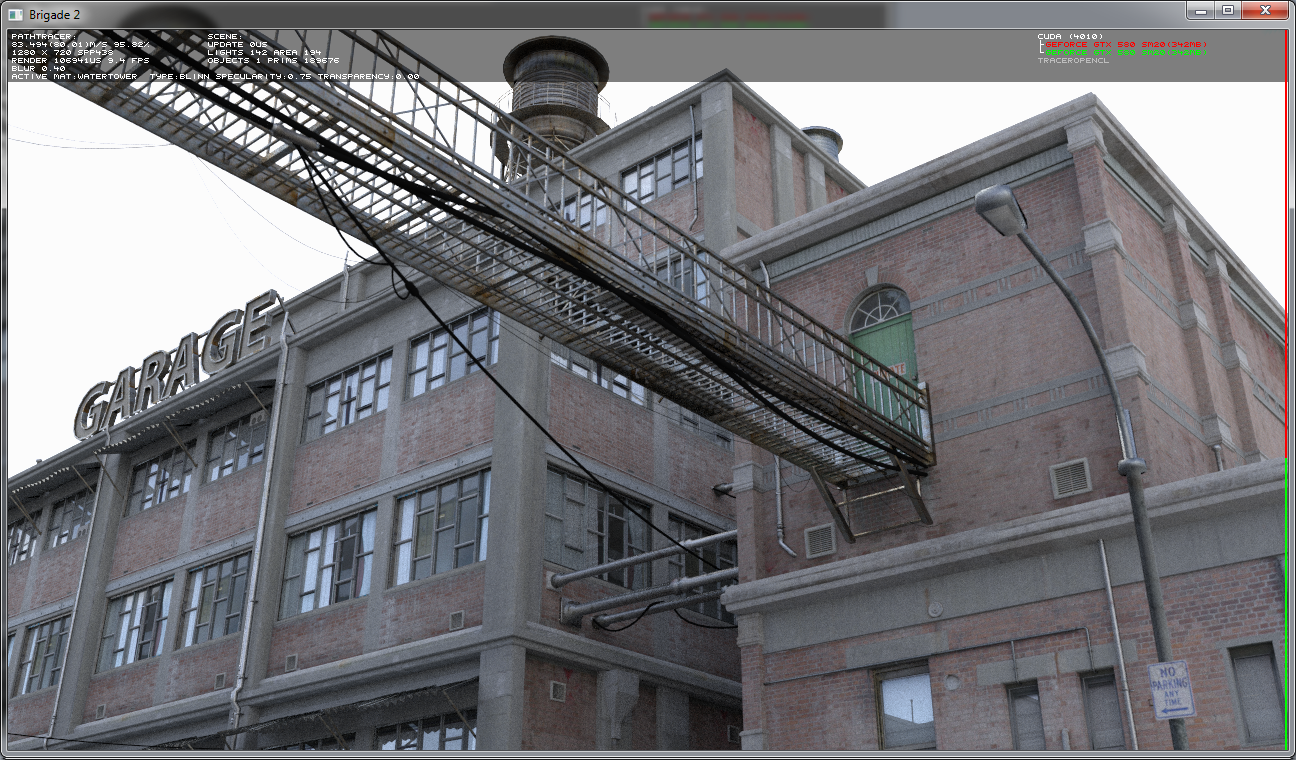
Some screens of a new scene (which might eventually be used in a small proof-of-concept game), rendered in real-time with Brigade (the scene is called "the Backstreets" and was made by Stonemason):

UPDATE: video