June 2008: Radeon HD 4870 launches with the OTOY/Cinema 2.0/Ruby tech demo featuring voxel raytracing. It can't get much closer to photorealism than this... or can it?
December 2010: Radeon HD 6970 launches with this craptastic tech demo. Talk about progress. Laughable fire effects, crude physics with only a few dozen dynamic objects, pathetic Xbox 1 city model and lighting, uninspired Mecha design. It may be just a tech demo but this is just a disgrace for a high-tech GPU company. Well done AMD! Now where the hell is that Cinema 2.0 Ruby demo you promised dammit? My HD 4890 is almost EOL and already LOL :p
Octane, my fav unbiased GPU renderer, will also implement an MLT-like rendering algorithm in the next verion (beta 2.3 version 6), which is "coming soon". I gathered some interesting quotes from radiance (Octane's main developer) regarding MLT in Octane:
“We are working on a firefly/caustic capable and efficient rendering algorithm, it's not strictly MLT but a heavily modified version of it. Trust me, this is the last big feature we need to implement to have a capable renderer, so it's our highest priority feature to finish.”
“MLT is an algorithm that's much more efficient at rendering complex scenes, not so efficient at simple, directly lit scenes (eg objects in the open). However MLT does sample away the fireflies.”
“The fireflies are a normal side effect of unbiased rendering, they are reflective or refractive caustics. We're working on new algorithms in the next version that will solve this as it will compute these caustics better.”
“they are caustics, long paths with a high contribution, a side effect of unbiased path tracing. MLT will solve this problem which is in development and slated for beta 2.3”
“the pathtracing kernel already does caustics, it's just not very efficient without MLT, which will be in the next 2.3 release.”
“lights (mesh emitters) are hard to find with our current algorithms, rendertimes will severely improve with the new MLT replacement that's coming soon.”
“it will render more efficiently [once] we have portals/MLT/bidir.”
“All exteriors render in a few minutes clean in octane currently. (if you have a decent GPU like a medium range GTX260 or better). Interiors is more difficult, requires MLT and ultimately bidir path tracing. However, with plain brute force pathtracing octane is the same or slightly faster than a MLT/Bidir complex/heavily matured [CPU] engine, which gives good promise for the future, as we're working on those features asap.”
With all unbiased rendering techniques soon possible and greatly accelerated on the GPU, what about GPU acceleration for biased production rendering techniques (such as photon mapping and irradiance caching)? There have been a lot of academic research papers on this subject (e.g. Purcell, Rui Wang and Kun Zhou, Fabianowski and Dingliani, McGuire and Luebke, ...), but since it's a lot trickier to parallellize photon mapping and irradiance caching than unbiased algorithms while still obtaining production quality, it's still not quite ready for integration in commercial software. But this will change very soon imo: on the ompf forum I've found a link to a very impressive video showing very high-quality CUDA-accelerated photon mappinghttp://www.youtube.com/watch?v=ZTuos2lzQpM.
This is a render of Sponza, 800x800 resolution, rendered in 11.5 seconds on 1 GTX 470! (image taken from http://kaikaiwang.blogspot.com/):
11 seconds for this quality and resolution on just one GPU is pretty amazing if you ask me. I'm sure that further optimizations could bring the rendertime down to 1 second. The video also shows real-time interaction (scale, rotate, move, delete) with objects from the scenery (something that could be extended to support many dynamic objects via HLBVH). I could see this being very useful for real-time production quality global illumination using a hybrid of path tracing for exteriors and photon mapping for interiors, caustics, point lights.
Just like 2010 was the year of GPU-accelerated unbiased rendering, I think 2011 will become the year of heavily GPU-accelerated biased rendering (photon mapping in particular).
This is probably the most significant news since the introduction of real-time path tracing on the GPU. I've been wondering for quite a while if MLT (Metropolis Light Transport) would be able to run on current GPU architectures. MLT is a more efficient and more complex algorithm than path tracing for rendering certain scenes which are predominantly indirectly lit (e.g. light coming through a narrow opening, such as a half-closed door, and illuminating a room), a case in which path tracing has much difficulty to find "important" contributing light paths. For this reason, it is the rendering method of choice for professional unbiased renderers like Maxwell Render, Fryrender, Luxrender, Indigo Render and Kerkythea Render. Dietger van Antwerpen, an IGAD student who co-developed the Brigade path tracer and who also managed to make ERPT (energy distribution ray tracing) run in real-time on a Fermi GPU, has posted two utterly stunning and quite unbelievable videos of his latest progress:
- video 1 showing a comparison between real-time ERPT and path tracing on the GPU: ERPT on the left, standard path tracing (PT) on the right. Light is coming in from a narrow opening, a scenario in which PT has a hard time to find light paths and converge, because it randomly samples the environment. ERPT shares properties with MLT: once it finds an important light path, it will sample nearby paths via small mutations of the found light path, so convergence is much faster.
- video 2 showing Kelemen-style MLT (an improvement on the original MLT algorithm) running in real-time on the GPU. The video description mentions Kelemen-style MLT on top of bidirectional path tracing (BDPT) with multiple importance sampling, pretty amazing. Kelemen-MLT after 10 seconds of rendering at 1280x720 on a single GTX 470. The beautiful caustics are possible due to bidirectional path tracing+MLT and are much more difficult to obtain with standard path tracing.
These videos are ultimate proof that current GPUs are capable of more complex rendering algorithms than brute-force standard path tracing and can potentially accelerate the very same algorithms used in the major unbiased CPU renderers. This bodes very well for GPU renderers like Octane (which has its own MLT-like algorithm), V-Ray RT GPU, SmallLuxGPU and iray.
If Dietger decides to implement these in the Brigade path tracer we could be seeing (quasi) noise-free, real-time path traced (or better "real-time BDPT with MLT" traced) games much sooner than expected. Verrrry exciting stuff!! I think some rendering companies would hire this guy instantly.
I think this deserves it's own post. Someone (Anonymous) told me that the OnLive service can be accessed and played from EU countries as well, so I gave it a try and downloaded and installed the tiny OnLive plug-in. To my surprise, I actually got it working on a pretty old PC (just a Pentium 4 at 3GHz). I was flabbergasted. I'm about 6000 miles away from the OnLive servers and it's still running! The quality of the video stream was more than decent and smoother than when I try to decode 720p Youtube videos which my system just cannot handle.
My first impression: I love it, now I'm absolutely positive that this is the very near future for video games. It's a joy to watch others play and to start playing the same game within seconds! I've tried some Borderlands, Splinter Cell Conviction and FEAR2. There is some lag, because I'm about 6000 miles away from the OnLive server (I got a warning during log-in that my connection has huge latency), but I could nevertheless still enjoy the game. About half a second (or less) passes between hitting the shoot key and seeing the gun actually shoot, and when moving your character . I must say though that I got used to the delay after a while, and I anticipated my moves by half a second. My brain notices the delay during the first minutes of play, but I forgot about it after a while and just enjoyed the game. I think that if I can enjoy an OnLive game from 6000 miles away, then US players, who live much closer to the OnLive servers, have got to have an awesome experience. The lag could also be due to my own ancient PC (which is not even dual core) or to the local network infrastructure here in Belgium even though I have a pretty big bandwidth connection. I can't wait until they deploy their EU servers. Image quality is very variable, I guess it's partly because of my PC, which cannot decode the video stream fast enough. FEAR 2 looked very sharp though. The image looks best when you're not moving the camera and just stare at the scene. The recently announced MicroConsole seems to offer very good image quality from what I've read.
I think that cloud gaming will give an enormous boost to the graphics side of games and that photorealistic games will be here much sooner thanks to cloud rendering and it's inherent rendering efficiency (especially when using ray tracing, see the interview with Jules Urbach). My biggest gripe with consoles like Xbox and Playstation is that they stall graphics development for the duration of the console cycle (around 5 years), especially the latest round of consoles. With the exception of Crysis, PC games don't make full use of the latest GPUs which are much more powerful than the consoles. I just ran 3DMark05 some days ago, and it's striking me that this 5-year old benchmark still looks superior than any console game on the market. I truely hope that cloud gaming will get rid of the fixed console hardware and free up game developers (and graphics engineers in particular) to go nuts, because I'm sick of seeing another Unreal Engine 3 powered game.
I also think that OnLive will not be the only player and that there will be fierce competition between several cloud gaming services, each with their own exclusive games. I can imagine a future with multiple cloud gaming providers such as OnLive, OTOY, Gaikai, PlayStation Little Big Cloud, Activision Cloud of Duty, EA Battlefield Cloud of Honor, UbiCloud, MS Red Ringing Cloud of Death (offering Halo: RROD exclusively), Valve Strrream... To succeed they would have to be accessible for free (just like OnLive is now), without monthly subscription fees.
All in all, it's an awesome experience and it's going to open up gaming for the masses and will give a new meaning to the word "video" game. The incredible ease of use (easier than downloading a song from the iTunes Store) will attract vast audiences and for this reason I think it's going to be much bigger than Wii and will completely shake up the next-gen console landscape (Wii2, PS4 and Xbox 2.5/720/RROD2/...). MS, Sony and Nintendo better think twice before releasing a brand new console.
Be it OnLive, OTOY, Gaikai or any other service, I, for one, welcome our new cloud gaming overlords!
The author currently has a job at OnLive, the cloud-gaming service, but before working there he used to write about voxel raytracing, sparse voxel octrees and the like. I assume he's working on some super-secret game graphics technology involving voxels and ray tracing, targeted to run on the cloud. Another main theme of the blog is how the brain works and how and when artificial intelligence could match and even surpass the capacity of the human brain (something which I find even more interesting than real-time path tracing). To achieve this dream (or nightmare, depending on your view), you would need a gigantic amount of computing power and cloud servers will probably first to fulfill that requirement. Could it be that one day OnLive will turn into SkyNet? ;-)
Such a suprahuman intelligence could help scientists think about cures for cancer, stem cell research, nanotechnology, the Palestine-Israelian conflict and could help them understand their wives ;-).
Lag is apparently not an issue at all and unnoticeable. Compression artefacts are there, but no dealbreaker and image quality will steadily improve in the coming years with better network speeds.
It's easy to see the huge possibilities that cloud gaming could offer: when it becomes successful, big publishers like EA and Activision could completely by-pass the classic consoles from money sucking Microsoft and Sony by hosting their own cloud game servers and stream their Battlefield and Call of Duty (2014 edition) directly to consumers, saving a shitload of dollars in the process. They could even host their games exclusively in the cloud, effectively rendering the Xbox and PlayStation obsolete.
And when everything has moved to the cloud, path traced games could finally make a breakthrough and become mainstream, due to the greater efficiency and "unlimited" rendering power of the cloud architecture.
For encoding and decoding of 1080p we just need a millisecond, which is negligible.A data packet travels the nearly 4,000 miles between New York and Los Angeles in 85 milliseconds, in addition there are about eight milliseconds input delay. So we are below our targeted 100 milliseconds which doesn't matter for a 3D shooter like Crysis. If we distribute our hosting offerings to five strategically placed data centers in the U.S., the total latency drops to around 30 milliseconds. Our biggest concern is therefor not so much the connection speed, but server-scaling. After all, it costs a lot of money to provide one GPU per user.This is where virtualization comes into play: for example, on a modern graphics card we can run eight instances of the CryEngine.We also do not stream games 24 hours a day.Only five to ten minutes go by, until enough data is present in the local cache (on the client side) to run it from there. A title such as Lego Batman is streamed in the background in a single minute on the client computer, which again frees up resources on the server.This works on both the Mac and the PC - and we are working on a special mini-hardware that does the job without a local computer.
So one of OTOY's goals is to stream the game data to your local PC or Mac, but you can instantly start playing the game remotely, while it's streaming to your local system until it can run locally.
The fundamental idea in the current paper is that one can take advantage of the parallel abilities of arbitrary computing machinery, from cloud computing to graphical cards (GPU), in the case of the generic IMH algorithm, producing an output that corresponds to a much improved Monte Carlo approximation machine at the same computational cost.
This could be very interesting for all the GPU renderers out there.
It looks like this card came out of nowhere, I hadn't heard much about it until a few weeks ago. Hopefully this launch event will include a new and exciting ray tracing tech demo à la Design Garage (after the rather disappointing launch of the Radeon HD 6800 cards with no tech demo's whatsoever). Maybe something OTOY/voxel ray tracing related ;D?
Some very interesting excerpts from the interview:
We can run 48 first person shooters at 60 fps on a single 1U server through ORBX. That is with legacy games that have not been optimized for our service (i.e. games that we run out of the box, without any modifications). When developers target our platform (through tools such as our raytracing pipeline), concurrent usage gets closer to 100 users per GPU. That is before you factor in local rendering power offloaded on the client.
The greater efficiency for rendering games in the cloud when using ray tracing could be the killer argument to start using ray tracing instead of rasterization (besides the simplicity of the code and the greater realism)!
OTOY's patnership with AMD, Nvidia and Intel:
SW: OTOY has been working closely with AMD. What are the major advantages of AMD’s technology relative to Nvidia and Intel?
JU: We were very deliberate in choosing to go down this path with AMD. We tested early versions of ORBX on Nvidia GPUs, x86 CPUs, and AMD GPUs. We settled on CAL as our core development platform (CAL is AMD‟s low level computing language). It was very challenging to program a GPU using CAL, which is not officially supported by AMD. But we were seeing amazing speeds which we could not replicate on other architectures.
As our company has evolved, so have our relationships with other major hardware vendors. This year, we‟ve added Intel and Nvidia as partners. More will follow. We announced Intel this summer. Obviously, we need CPUs on our servers as well as GPUs. And, in that respect, Intel has a very compelling offering. Intel is also developing hardware cards made from densely packed x86 cores which we may use in the future.
We are officially announcing our partnership with Nvidia in a few weeks. We have been working with them on a version of ORBX that will be deployed on Nvidia hardware in 2011. This is not trivial, given that ORBX‟s speed has, up until now, come from functionality that is specific to AMD hardware. But, from a practical perspective, we would be ignoring a significant portion of the professional graphics market if we didn‟t support CUDA applications. Adobe Photoshop, CS5, and countless other apps only support CUDA.
and about unbiased rendering:
Just as I see rendering moving towards an unbiased model that becomes as simple as photography, I can imagine high performance computing and software development becoming equally democratized.
I'm talking about farrarfocus (Timothy Farrar), repiblog, level of detail, enter the singularity, too many pixels... no more updates in ages. Did Twitter kill blogging? Or is interesting graphics development just slowing down? I think it's the former :( On the other hand, Carmack uses Twitter to chat about his graphics endeavours, so all is not bad.
- "Games/Apps –100% in the cloud by 2014" !!! this doesn't sound too far-fetched considering the success of OnLive and the growing interest from major game publishers and developers in the cloud platform.
- "High level web services enable path-tracing and LightStage rendering in any 3D engine"
- "Crytek engine on Facebook"
Real-time path tracing and GPU cloud servers, it's a match made in heaven (or in the cloud actually) .
Very nice work again from Bikker and co. A level from Minecraft, the current hype in indie games, that is path traced in near real-time using the Brigade path tracer! Enjoy: http://www.youtube.com/watch?v=7REP_FE0e98
The path traced lighting does look completely different from the lighting in the original Minecraft game, which isn't bad but not nearly as realistic.
This new video shows that even with the current hardware, there is still a lot of potential left to reduce noise and improve the image quality of real-time path traced graphics through better algorithms (importance sampling, maybe ERPT or something similar to MLT) and filtering methods.
Octane Render, the ultra-fast unbiased GPU renderer (made in Belgium just like me :-)) is soon going to introduce a new MLT-(Metropolis light transport)-like algorithm, which will make the rendering of certain difficult scenes with small light sources much more efficient: the scene will converge much faster, with less noise and will kill fireflies (bright pixels as a consequence of long paths from reflective caustics).
MLT is the base rendering algorithm used by unbiased CPU renderers like LuxRender, Maxwell Render, Fryrender, Indigo Renderer and Kerkythea.
Making Metropolis light transport (or an equivalent) work on current GPUs was thought by many to be impossible and it was one of the main criticisms from GPU rendering skeptics such as Luxology (Modo) and Next Limit (Maxwell Render), who believe that GPUs can only do dumb, inefficient path tracing and nothing more. Luckily there's Octane Render to prove them wrong. The fact that it has taken the developer such a long time to make it work shows that it's quite tricky to develop. Octane Render is currently also the only renderer (to my knowledge) that will utilise a more sophisticated rendering algorithm.
On a sidenote, ERPT (energy redistribution path tracing) is also possible on the GPU, as described in one of my previous posts. It combines the advantages of Monte Carlo path tracing and Metropolis light transport to allow faster convergence with less noise and can achieve fantastic results, which look indistinguishable from the path traced reference (see http://raytracey.blogspot.com/2010/09/small-update-on-brigade-real-time-path.html) Timo Aila, a graphics researcher at Nvidia and GPU ray tracing genius, is also working on real-time Metropolis light transport (http://research.nvidia.com/users/timo-aila).
Octane's MLT-like algorithm has been hinted at by its developer since the unveiling of the software in January 2010, and it should be here very soon (within a couple of weeks, post will be updated when that happens). I'm very curious to see the first results.
Future GPU architectures, like Kepler and Maxwell, should make the implementation of MLT-like algorithms on the GPU much easier, but it's nice to see at least one developer trying to squeeze the maximum out of current GPUs, bending their compute capability until it breaks.
At GTC 2010, Nvidia announced their future GPUs named Kepler and Maxwell. One of the more interesting quotes: "Between now and Maxwell, we will introduce virtual memory, pre-emption, enhance the ability of the GPU to autonomously process, so that it's non-blocking of the CPU, not waiting for the CPU, relies less on the transfer overheads that we see today. These will take GPU computing to the next level, along with a very large speed up in performance," said Jen-Hsun Huang.
Pre-emption was already revealed in a slide from a presentation by Tony Tomasi at Nvision08 (http://www.pcper.com/article.php?aid=611), depicting a timeline showing pre-emption, full support for function pointers, C++, etc. :
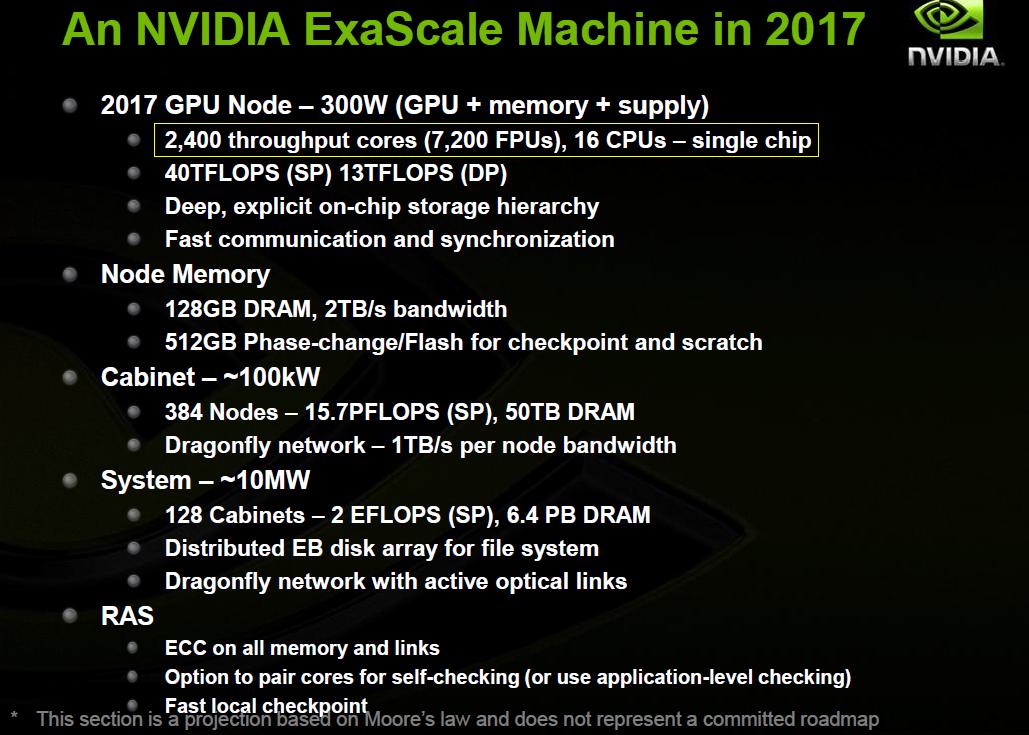
The part about "the ability of the GPU to autonomously process, so that it's non-blocking of the CPU, not waiting for the CPU, relies less on the transfer overheads that we see today" is very interesting and suggests the incorporation of CPU cores on the GPU, as shown in a slide from an Nvidia presentation at SC09 (http://www.nvidia.com/content/GTC/documents/SC09_Dally.pdf):
We all know that Intel and AMD are looking at merging CPU cores and GPUs on the same die. In my mind, the future is for hybrid computing, where different kind of processors working together and find their own kind of tasks to work on. Currently, multi-core CPU and many-core GPU are working together, tasks are distributed by software schedulers. Data parallel tasks are assigned to GPUs and task-parallel jobs are assigned to GPUs. However, communication between these two kinds of processors is the performance bottleneck. I hope NVIDIA can provide a solution on their desktop GPU product line too.
Bill Dally:
That's exactly right. The future is heterogeneous computing in which we use CPUs (which are optimized for single-thread performance) for the latency sensitive portions of jobs, and GPUs (which are optimized for throughput per unit energy and cost) for the parallel portions of jobs. The GPUs can handle both the data parallel and the task parallel portions of jobs better than CPUs because they are more efficient. The CPUs are only needed for the latency sensitive portions of jobs - the serial portions and critical sections.
Do you believe a time will come when GPU and CPU are on the same chip or "board" it seems the logical next step to avoid the huge PCI-E latency and have a better GPU-CPU interactivity ? i know there is ongoing research in this area already ...but what is your personal opinion on the possibility and benefits of this ?"
Bill Dally:
Our Tegra processors already combine CPUs and a GPU on a single chip. For interactivity what's important is not the integration but rather having a shared memory space and low latency synchronization between the two types of cores. I don't see convergence between latency-optimized cores and throughput optimized cores. The techniques used to optimize for latency and throughput are very different and in conflict. We will ultimately have a single chip with many (thousands) of throughput cores and a few latency-optimized cores so we can handle both types of code.
From the above slide, Nvidia expects to have 16 CPU cores on the GPU by 2017, deducing from that you would get:
- 2017: GPU with 16 CPU cores - 2015: GPU with 8 CPU cores - 2013: Maxwell with 4 CPU cores - 2011: Kepler with 2 CPU cores
My bet is that Kepler will at least have one and probably two (ARM based) CPU cores and Maxwell will probably have 4 CPU cores on the GPU. The inclusion of true CPU cores on the GPU will make the CPU-GPU bandwidth problem of today obsolete and will enable smarter ray tracing algorithms like Metropolis light transport and bidirectional path tracing on the GPU. Biased rendering methods such as photon mapping and irradiance caching will be easier to implement. It will also give a tremendous performance boost to the (re)building of acceleration structures and to ray tracing of dynamic geometry, which will no longer depend on the slow PCIe bus. Apart from ray tracing, most other general computation tasks will also benefit greatly. I think this CPU/GPU combo chip will be Nvidia's answer to AMD's oft-delayed Fusion and Intel's Sandy Bridge.
OTOY will also make use of CUDA in the future which is great news!!! Hopefully this will speed up adoption of the technology by a factor of 10 to 50x ;-)
UPDATE: here's the full PR release:
OTOY to Present Enterprise Cloud Platform at NVIDIA GPU Technology Conference
OTOY will unveil its Enterprise Cloud platform at the GPU Technology Conference this week. The platform is designed to enable developers to leverage NVIDIA CUDA, PhysX and Optix technologies through the cloud.
Santa Clara, CA (PRWEB) September 23, 2010
OTOY announced that it will unveil its Enterprise Cloud platform at the GPU Technology Conference this week. The platform is designed to enable developers to leverage NVIDIA CUDA, PhysX and Optix technologies through the cloud. OTOY's proprietary ORBX GPU codec will enable high performance 3D applications to render on a web server and instantly stream to any thin client.
OTOY is participating in the GTC “Emerging Companies Summit,” a two-day event for developers, entrepreneurs, venture capitalists, industry analysts and other professionals.
OTOY Enterprise Cloud platform The OTOY Enterprise Cloud platform sandboxes an application or virtual machine image without degrading or limiting GPU performance. CUDA-powered applications, such as Adobe's Creative Suite 5, will be able to take full advantage of GPU acceleration while streaming from a virtual OTOY session.
OTOY bringing GPGPU to the browser In addition to supporting CUDA through its server platform, OTOY's 4k web plug-in adds CUDA and OpenCL compliant scripting across all major web browsers, including Internet Explorer, Mozilla FireFox, Google Chrome, Apple Safari and Opera. GPU web applets that cannot run locally are executed and rendered using OTOY server side rendering. This ensures that GPU web applets can be viewed on any client, including HTML 4 browsers.
Next generation rendering tools coming to developers OTOY enables server hosted game engines to render LightStage assets and leverage distributed GPU ray-tracing or path-tracing in the cloud. The OTOY Enterprise Cloud platform can host complete game engine SDKs, making game deployment to Facebook or other web portals simple and instantaneous.
OTOY will add native support for CryEngine content in 2011, starting with Avatar Reality's Blue Mars. Blue Mars is the first virtual world built using the Crytek engine. It is currently in beta testing on the OTOY platform.
About OTOY OTOY is a leading developer of innovative software solutions for GPU and CPU hardware, as well as a provider of convergence technologies for the video game and film industries. OTOY works with a wide range of movie studios, game developers, hardware vendors and technology companies.
OTOY integrated in CryEngine and supporting distributed GPU ray tracing and path tracing in the cloud!! The dream of real-time ray traced or even path traced games is getting closer every day! I do hope that OTOY will deliver this dream first, they have all the right technology and partners now.
Jacco Bikker has released two new video's of the progress with his real-time path tracer named Brigade, demonstrating some kind of game where a truck has to push gold containers or something. Looks fun:
There is also an update from Dietger van Antwerpen on the GPU path tracer (subsystem of Brigade path tracer) running with the more advanced ERPT (energy redistribution path tracing) algorithm. He has improved the ERPT code to produce virtually identical results to the path traced reference and released a high quality image with it (ERPT on the left and path tracing on the right):
"After some complains pointing out that in the movie, ERPT is significantly darker then path tracing , I fixed the darkening effect of the ERPT image filter, solving the difference in lighting quality. I made an image ( http://img844.imageshack.us/img844/7... ) using ERPT for the left half, while using path tracing for the right half and waited until the path tracing noise almost vanished. As you can see, the lighting quality between the left and right half is pretty much the same. (The performance and convergence characteristics remain unchanged)"
It would be interesting to know the time for ERPT and for path tracing to achieve these results.
As the videos show, ERPT converges considerably faster than standard path tracing and the noise is significantly reduced. Very cool and very impressive. I wonder if the optimized ERPT code will be used in Brigade for real-time animations and games.
"a real-time massive model visualization engine called VoxLOD, which can handle data sets consisting of hundreds of millions of triangles.
It is based on ray casting/tracing and employs a voxel-based LOD framework. The original triangles and the voxels are stored in a compressed out-of-core data structure, so it’s possible to explore huge models that cannot be completely loaded into the system memory. Data is fetched asynchronously to hide the I/O latency. Currently, the renderer runs entirely on the CPU.
...
I’ve implemented shadows in VoxLOD, which has thus become a ray tracer. Of course, level-of-detail is applied to the shadow rays too.
While shadows make the rendered image a lot more realistic, the parts in shadow are completely flat, devoid of any details, thanks to the constant ambient light. One possible solution is ambient occlusion, but I wanted to go further: global illumination in real-time.
GI in VoxLOD is very experimental and unoptimized for now. It’s barely interactive: it runs at only 1-2 fps at 640×480 on my dual-core Core i7 notebook. Fortunately, there are lots of optimization opportunities. Now let’s see an example image:
Note that most of the scene is not directly lit, and color bleeding caused by indirect lighting is clearly visible. There are two light sources: a point light (the Sun) and a hemispherical one (the sky). I use Monte Carlo integration to compute the GI with one bounce of indirect lighting. Nothing is precomputed (except the massive model data structure of course).
I trace only two GI rays per pixel, and therefore, the resulting image must be heavily filtered in order to eliminate the extreme noise. While all the ray tracing is done on the CPU, the noise filter runs on the GPU and is implemented in CUDA. Since diffuse indirect lighting is quite low frequency, it is adequate to use low LODs for the GI rays."
There is a very interesting graph in this paper, which shows that when using LOD, the cost of ray casting remains constant once a certain number of triangles (0.5M) is reached:
Quoting the paper,
"by using LODs, significantly higher frame rates can be achieved with minimal loss of image quality, because ray traversals are less deep, intersections with voxels are implicit, and memory accesses are more coherent. Furthermore, the LOD framework can also reduce the amount of aliasing artifacts, especially in case of highly tesselated models."
"Our LOD metric could be also used for several types of secondary rays, including shadow, ambient occlusion, and planar reflection rays. One drawback of this kind of metric is that it works only with secondary rays expressible as linear transformations. Because of this, refraction and non-planar reflection rays are not supported."
Implemented on the GPU, this tech could be the ideal solution for real-time raytracing in games:
- it makes heavy use of LOD for primary, shadow and GI rays which greatly reduces their tracing cost
- LOD is generated automatically by the voxel data structure
- nearby geometry is represented by triangles, so there isn't any voxel blockiness on close inspection
- characters and other dynamic geometry can still be represented as triangles and as such avoid the difficulties with animating voxels
- huge immensely detailed levels are possible thanks to the out-of-core streaming of the voxels and triangles
- it uses Monte Carlo GI, which scales very easily (number of bounces + number of samples per pixel) and can be filtered, while still giving accurate results
Are there any plans to add fixed function raytracing hardware to the GPU?
David Luebke: Fixed-function ray tracing hardware: our group has definitely done research in this area to explore the "speed of light", but my sense at this time is that we would rather spend those transistors on improvements that benefit other irregular algorithms as well. ray-triangle intersection maps well to the GPU already, it's basically a lot of dot products and cross products. ray traversal through an acceleration structure is an interesting proxy for lots of irregular parallel computing workloads : there is abundant parallelism but it is branchy and hard to predict. Steps like Fermi's cache and unified memory space are great examples of generic hardware improvements that benefit GPU ray tracing as well as many other workloads (data mining, tree traversal, collision detection, etc)
When do you think real-time ray tracing of dynamic geometry will become practical for being used in games?
David Luebke:
ray tracing in games: I think Jacopo Pantaleoni's "HLBVH" paper at High Performance Graphics this year will be looked back on as a watershed for ray tracing of dynamic content. He can sort 1M utterly dynamic triangles into a quality acceleration structure at real-time rates, and we think there's more headroom for improvement. So to answer your question, with techniques like these and continued advances in GPU ray traversal, I would expect heavy ray tracing of dynamic content to be possible in a generation or two.
Currently there is a huge interest in high quality raytracing on the GPU. The number of GPGPU renderers has exploded during the last year. At the same time there are critics saying that GPU rendering is still not mature enough to be used in serious work citing a number of limitations such as not enough memory, shaders are too simple and that you can only do brute force path tracing on the GPU, which is very inefficient compared to the algorithms used in CPU renderers. What is your take on this? Do you think that these limitations are going to be solved by future hardware or software improvements and how soon can we expect them?
David Luebke:
re offline renderers - I do think that GPU performance advantages are becoming too great for studios to ignore. You can definitely get way past simple path tracing. I know of a whole bunch of studios that are doing very deep dives. Stay tuned!
Do you think rasterization is still going to be used in 10 years?
David Luebke:
re rasterization: yes, forward rasterization is a very energy-efficient way to solve single-center-of-projection problems (like pinhole cameras and point light shadow maps) which continue to be important problems and subproblems in rendering. So I think these will stick around for at least another 10 years
There have been a lot of papers about reyes style micropolygon rasterizing at past graphics conferences with the feasibility of hardware implementation. Do you think this is a good idea?
David Luebke:
re: micropolygons - I think all the work on upolys is incredibly interesting. I still have some reservations about whether upolys are REALLY the final answer to rendering in the future. They have many attractive attributes, like the fact that samples are glued to parametric space and thus have good temporal coherence, but they seem kind of ... heavyweight to me. There may be simpler approaches.
am I wrong in thinking that game graphics are limited more by the artist than the graphics or are the game companies just trying to reach a broader market?
David Luebke:
you are not wrong! game developers are limited by artists, absolutely. But this translates to graphics - better graphics means simpler, more robust, easier to control and direct graphics. A good example is cascaded shadow maps, used very widely in games today. These are notoriously finicky and artists have to keep a lot of constraints in their head when designing levels etc. Looking forward, increased GPU performance and programmability both combine to make simpler approaches - like ray tracing - practical. On the flip side, graphics is certainly not solved and there are many effects that we can't do at all in real-time today, so you will continue to see games push forward on graphics innovation, new algorithms, new ways to use the hardware
UPDATE: Some tech websites such as xbitlabs, have taken the comment from the live chat about rasterization out of context, stating that we will have to wait at least another 10 years before ray tracing will be used in games. Apparently, they didn't read the answers from David Luebke very well. The way I understood it, is that rasterization will be used in conjunction with ray tracing techniques, both integrated in novel rendering algorithms such as image space photon mapping. From the ISPM paper:
Image Space Photon Mapping (ISPM) rasterizes a light-space bounce map of emitted photons surviving initial-bounce Russian roulette sampling on a GPU. It then traces photons conventionallyon the CPU. Traditional photon mapping estimates final radiance by gathering photons from a k-d tree. ISPM instead scatters indirect illumination by rasterizing an array of photon volumes. Each volume bounds a filter kernel based on the a priori probability density of each photon path. These two steps exploit the fact that initial path segments from point lights and final ones into a pinhole camera each have a common center of projection.
So ray tracing in games will definitely show up well within 10 years and according to Luebke you can expect "heavy ray tracing of dynamic content to be possible in a generation or two". Considering that Fermi was a little bit behind schedule, I would expect Nvidia's next generation GPU to come around March 2011 (on schedule), and the generation after that around September 2012. So only 2 years before real-time raytracing is feasible in games ;-D.